

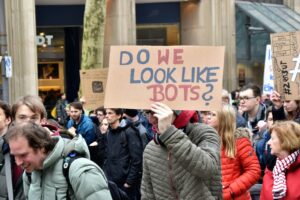


Another joker is about to take a stab at the age-old question: “Will AI take our jobs?” The simple, no-nonsense answer is this: It’s not about jobs being taken; it’s about work being transformed. AI is here to free us from the mundane, not to render us obsolete. It’s an opportunity for us to design a more meaningful professional life, where our time is spent on what truly matters.
In This Blog Post
-
The Big Shift: We’ll explore which tasks are best suited for machines and which are best left to humans.
-
The Path to Adaptation: We’ll discuss how to teach your workforce to not just accept, but to thrive with AI tools.
-
The Human Advantage: We’ll highlight the benefits to us—the humans—when AI is implemented effectively.
-
The New Frontier of Leadership: We’ll examine what leadership looks like in a future focused on creativity and strategy.
The AI-Human Partnership: Who Does What?
To effectively leverage AI, you must first understand its core strengths: automation, data analysis, and pattern recognition. The most productive workplaces don’t pit humans against machines; they find synergy by assigning tasks based on complementary strengths.
-
AI’s Role: AI excels at tasks that are repetitive, high-volume, and data-driven. This includes things like:
-
Automating data entry and scheduling.
-
Drafting and summarizing content.
-
Analyzing large datasets to forecast trends.
-
Processing routine customer inquiries.
-
-
Humanity’s Domain: The human mind is still a force to be reckoned with. We possess crucial skills that AI cannot replicate. Our unique value lies in contextual understanding, critical evaluation, and emotional intelligence. The tasks that belong to us are those that require:
-
Creative direction and strategic planning.
-
Complex problem-solving.
-
Building meaningful relationships and fostering team engagement.
-
Empathetic leadership and a nuanced understanding of human behavior.
-
By offloading the “busy work” to AI, we free ourselves to focus on the high-value, meaningful work that only we can do. This isn’t about working less; it’s about working smarter and with more purpose.
Radical Responsibility: Equipping Your Team to Adapt
Adopting AI is not a one-time event; it’s a continuous process that requires a fundamental shift in mindset. As the user’s philosophy emphasizes radical responsibility, the onus is on both the organization and the individual to embrace this change. Leadership must provide the tools and training, and employees must take the initiative to learn and adapt.
Training should be practical and hands-on, focusing on real-world use cases. It should cover:
-
Basic AI literacy to demystify the technology and address misconceptions.
-
Prompt engineering, teaching employees how to communicate effectively with AI systems to get accurate and valuable outputs.
-
Ethical guidelines for using AI responsibly and safeguarding data.
One of the most effective ways to encourage adoption is to integrate hands-on training where employees can build simple AI tools for their day-to-day tasks. This creates an “aha” moment that builds confidence and enthusiasm, transforming a perceived threat into an indispensable partner.
The Alpha State of Mind: The Human Benefits of an AI Workforce
When AI is effectively integrated, it doesn’t just boost a company’s bottom line; it elevates the human experience of work. It’s an opportunity to cultivate a healthier, more fulfilled workforce.
-
Enhanced Productivity and Efficiency: By automating repetitive and mundane tasks, AI allows employees to achieve more in less time and with fewer errors. This can lead to a better work-life balance and reduced stress.
-
A Focus on Creativity: With administrative tasks off their plates, employees can dedicate their time and mental energy to more creative and strategic endeavors. AI acts as an amplifier, helping professionals deliver better results faster, while leaving space for personal projects and innovation.
-
A Culture of Growth: AI can provide personalized learning and development opportunities, identifying skill gaps and recommending tailored training programs. This empowers employees to continuously grow and advance their careers, fostering a culture of lifelong learning.
The goal is not to have an easier job, but to have a more fulfilling one. We can free ourselves to be more creative, strategic, and human—and that is a purpose worth pursuing .
Leading the Future-Proof Workforce
The final piece of this puzzle is leadership. As our workforce becomes increasingly focused on creative and strategic tasks, the traditional leadership model must evolve. Leadership in an AI-augmented world is no longer about managing tasks; it’s about inspiring people and cultivating an environment where they can thrive.
-
Fostering Creativity: Leaders must build a culture that encourages innovation and new ideas, where employees feel safe to experiment and take risks without fear of failure.
-
Empowering Your Team: The new leader is a facilitator, not a micromanager. They must empower their teams, trusting them to navigate complex problems and own the results.
-
A Vision for the Future: A creative leader is a storyteller who can articulate a compelling vision and inspire their team to join them on the journey.
The goal is to move from a position of control to one of influence. Leaders must focus on team engagement and building a legacy of innovation and radical responsibility.
Ultimately, the power of AI lies in its ability to give us back our time and energy. It’s a tool to help us design a life by design, not by default. By embracing this technology, we can reject the victim mentality and take radical responsibility for our professional growth, creating a future where our work is not just productive, but truly meaningful.
Do you know someone who needs to hear this? Share this post with them and start the conversation.