

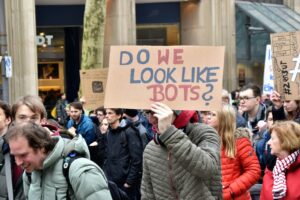


Artificial intelligence (AI) is no longer just a futuristic concept; it’s here, it’s evolving rapidly, and it’s shaping our world. Yet, despite its growing presence, many misconceptions and myths about AI persist. These common AI misconceptions can lead to unnecessary fear or unrealistic expectations. Let’s separate fact from fiction and explore the five most prevalent AI fallacies circulating today.
1. Myth: AI Will Steal Every Job (The Job Apocalypse Fallacy)
One of the most anxiety-inducing myths about AI is the idea that intelligent machines will completely take over human jobs, leading to widespread unemployment.
The Reality: While AI and automation will undoubtedly transform the job market, the complete eradication of human roles is highly unlikely. Historically, technological advancements have always created new industries and job categories. AI is expected to augment human capabilities, handling repetitive or data-heavy tasks, thereby freeing people to focus on creativity, complex problem-solving, and interpersonal skills. The future will likely see a collaborative workforce where humans and AI work together, each contributing their unique strengths. Think of AI as a powerful tool, not a human replacement.
2. Myth: AI is Conscious and Superintelligent (The Skynet Syndrome)
Fueled by Hollywood blockbusters, another pervasive AI myth is that AI systems are on the verge of developing consciousness, emotions, or even superior intelligence that could threaten humanity.
The Reality: Current AI systems are examples of “narrow AI” or “weak AI.” This means they are designed to perform very specific tasks exceptionally well – like recognizing faces, playing chess, or translating languages. They operate based on complex algorithms and vast datasets but lack genuine understanding, self-awareness, or consciousness. The concept of “general AI” (AGI), which would possess human-like cognitive abilities across various domains, remains a distant and theoretical goal. Today’s AI is powerful but not sentient.
3. Myth: AI is Always Objective and Unbiased (The Flawed Impartiality Belief)
Many assume that because AI operates on logic and data, its decisions must be inherently fair, impartial, and free from human bias. This is one of the more dangerous misconceptions about AI.
The Reality: AI models learn from the data they are fed, and if that data reflects existing societal biases (e.g., related to gender, race, or socioeconomic status), the AI will learn and potentially perpetuate those biases in its outputs. For example, an AI trained on skewed historical hiring data might unfairly favor certain demographics. Ensuring fairness, transparency, and mitigating bias in AI systems is a critical and ongoing challenge for developers and researchers. AI is only as unbiased as the data it learns from.
4. Myth: AI and Machine Learning Are the Same Thing (The Interchangeable Terms Trap)
It’s common to hear “AI” and “Machine Learning” used interchangeably, leading to confusion about their distinct meanings.
The Reality: Artificial Intelligence (AI) is the broader concept – the overarching goal of creating machines that can simulate human intelligence. It encompasses many techniques. Machine Learning (ML) is a subset of AI. It’s a specific method that enables machines to learn from data without being explicitly programmed for every scenario. Think of it this way: all machine learning is AI, but not all AI is machine learning. Deep learning, in turn, is a specialized form of machine learning that uses multi-layered neural networks.
5. Myth: AI is a “Magic Box” That Can Solve Any Problem (The Universal Solution Illusion)
There’s a prevailing notion that AI is a mystical, all-powerful tool capable of instantly solving any complex problem with minimal effort. This is a significant AI fallacy.
The Reality: Developing and implementing effective AI systems is an intricate process. It requires vast amounts of high-quality, relevant data, substantial computational resources, and specialized human expertise in areas like data science, engineering, and ethics. Not every problem is suitable for an AI solution, and sometimes simpler, more traditional approaches are more efficient. The successful application of AI depends on a clear understanding of the specific problem, a realistic assessment of the technology’s capabilities, and careful integration into existing workflows. It’s a powerful tool, but not a magic wand.
By understanding these common myths about AI, we can approach this transformative technology with a more informed and realistic perspective, fostering innovation and responsible development. What other AI misconceptions have you encountered? Share your thoughts in the comments below!